
About Vertex for Shopify
Everything you need to integrate the connector right away.
The Vertex® for Shopify® connector provides automated global indirect tax determination and compliance for sales and use tax, goods and services tax (GST), and value added tax (VAT). The connector streamlines tax calculation for business-to-business (B2B) and business-to-consumer (B2C) transactions in a cloud-based tax engine.
The connector integration enables location identification and complex taxability logic, delivering tax calculations for every transaction—including quotes, orders, invoices, and refunds—while supporting the latest tax content with reduced system update requirements.
Related documents
For more information about the latest release, see the Vertex for Shopify Release Notes.
The Vertex Community requires an active account.
Understanding how data flows
Shopify is a cloud-based e-commerce platform that enables businesses to create online stores, manage products, process payments, and sell to customers across online and in-person channels. You can install and configure the Vertex for Shopify connector in your Shopify admin.
The connector sends transaction and address details from Shopify to Vertex O Series for tax calculation. Vertex O Series applies the appropriate tax rules and rates, calculates the tax, and returns it to the connector. The connector then sends the calculated tax to Shopify.
Tax calculation
Here's what happens during tax calculation.
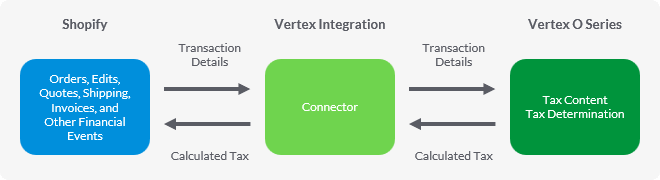
The connector sends transaction and address details from Shopify to Vertex O Series for tax calculation. The connector then sends the calculated tax to Shopify.
Order fulfillment
Here's what happens during order fulfillment.
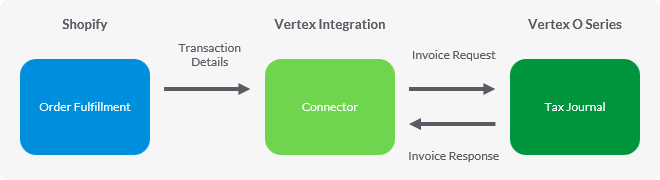
The connector sends the transaction and address details from Shopify to Vertex O Series, which logs the request and records them in the tax journal.
Order edits and refunds
The connector supports tax calculations for order edits and refunds.
Complete order edits and refunds within 90 days of the original order date. Vertex O Series stores orders for 90 days after the original order date. After 90 days, the connector might not process order edits or refunds automatically.
Note:The connector doesn't support arbitrary refunds.
When editing an existing order and adding a new line item, O Series calculates tax using the original order date, not the edit date. This behavior preserves the transaction's original effective tax date.
For example, if you create an order on January 1 and complete order fulfillment on January 15, O Series uses January 1 as the effective tax date. If you edit the same order on February 10 and add a new line item, O Series continues to calculate tax based on the original order date of January 1 rather than the edit date of February 10. If tax rates change between those dates, the calculated tax might differ from the tax that would apply on the edit date.
The order fulfillment date determines the transaction posting date for reporting purposes only. It doesn't affect tax calculations.
To help ensure accurate tax calculations, avoid adding new line items to existing orders when tax rates or rules may have changed since the original order date. Instead, create a new order so O Series calculates tax using the current effective tax date.
Sales channels and marketplaces
The connector supports tax calculation across multiple sales channels and marketplaces. However, the connector automatically excludes sales channel orders from invoicing and journaling to prevent double taxation when those channels are responsible for tax calculation.
Updated 1 day ago